The
project will identify and describe the modes and mechanisms of
deterioration, as
well as the
damage thresholds for
the traditional structures and standing architecture of Pecos.
The University of
Pennsylvania Center for Architectural Conservation partnered with the
National Park Service (NPS) through the Cooperative Ecosystem Studies
Units (CESU) Network. This network is a national consortium
of federal agencies, tribes, academic institutions, state and local
governments, nongovernmental conservation organizations, and other
partners working together to support informed public trust resource
stewardship.
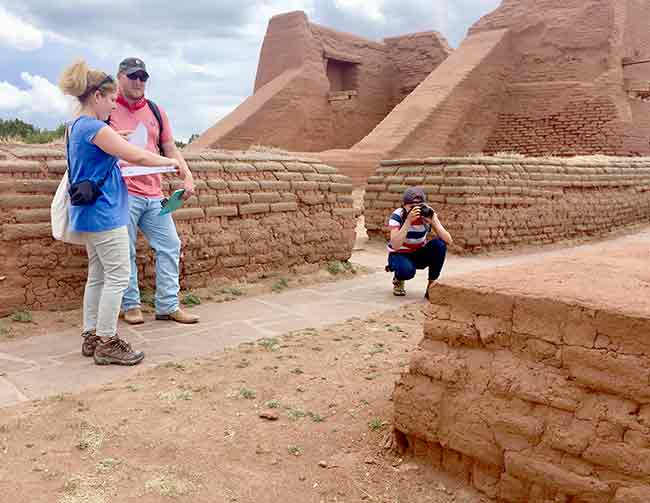
Team members developing a survey
methodology. The low walls in the forground delineate the convento
while the high walls in the back are the walls of the 18th century
church.
The multi-phase project at Pecos National Monument builds
off of the work carried
out by the CAC at Fort Union National Monument to develop monitoring
protocols to identify short- and long-term vulnerabilities of
traditionally-built historic resources (sites) in the arid west. The
protocols developed will allow NPS management to develop more informed
conservation and management (preservation) plans for these sites.
The project identifies and describes the modes and mechanisms of
deterioration of traditional structures and standing architecture, as well as
damage thresholds. Vulnerabilities based on factors such as
composition, construction, orientation, exposure, past treatment, and
maintenance are discussed and outlined.
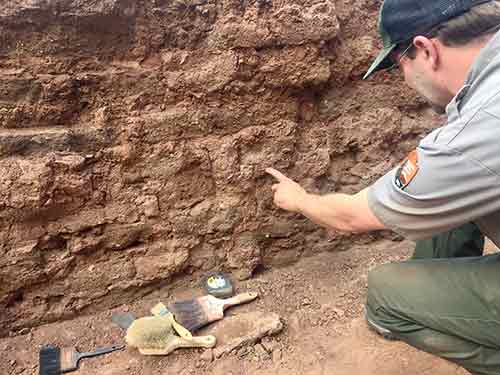
A park service employee inspecting the
surface of an exposed original wall.
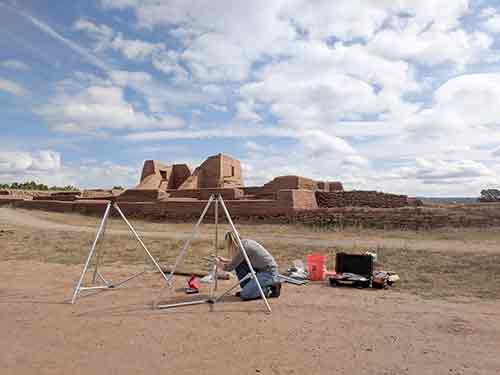
A CAC team member working to construct
tripods for mounting time lapse camers which will be maintained during
the full durations of the project.
Students
and researchers from
the Center for Architectural Conservation are further developing their
skills in, and
knowledge of historic preservation through participation in
on-the-ground
projects.
Information from this project will be disseminated throughout the
professional
historic preservation community to ensure that non-NPS sites in the
arid west
benefit from the research.
Phase One
Phase I attempts to address three primary goals.
Organizing Baseline Documentation,
including stabilization documentation for the 18th Century Mission
Church and Convento Complex and creating a Conservation History Database
Developing a Condition Assessment and Monitoring program for adobe walls in the
Convento
Initiating time lapse photography at the site for future use
in analyzing climatic data.